Why dust in switchgear becomes a risk
Dry dust usually conducts very little current. It becomes critical once moisture is added: IEC 60664-1, the standard for insulation coordination, expressly allows for pollution degree 3, in which dry, non-conductive pollution becomes conductive due to condensation. Add to that metal chips and debris left over from construction and renovation work. Cleaning here is not about appearance. It is about insulation and operational reliability.
What we clean
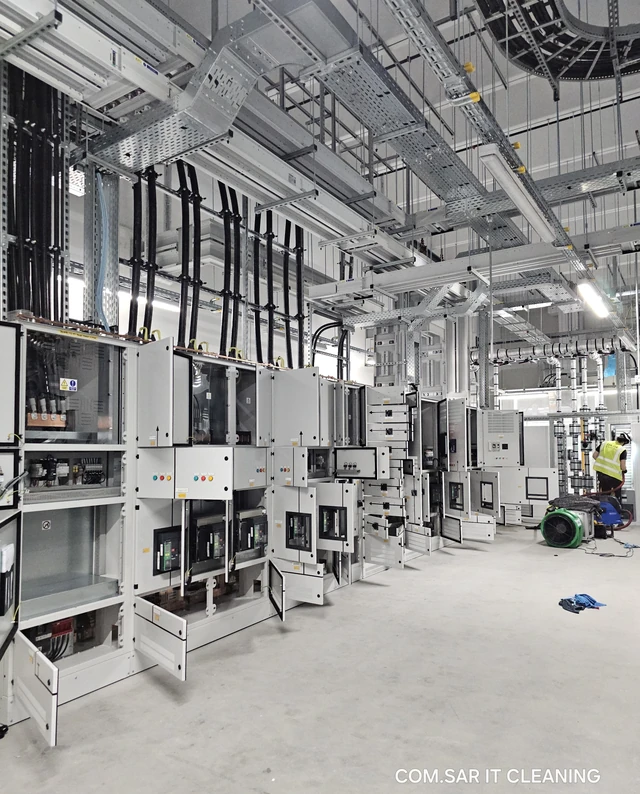
- Medium- and low-voltage switchgear: enclosures, interior surfaces, internal components and the surrounding area.
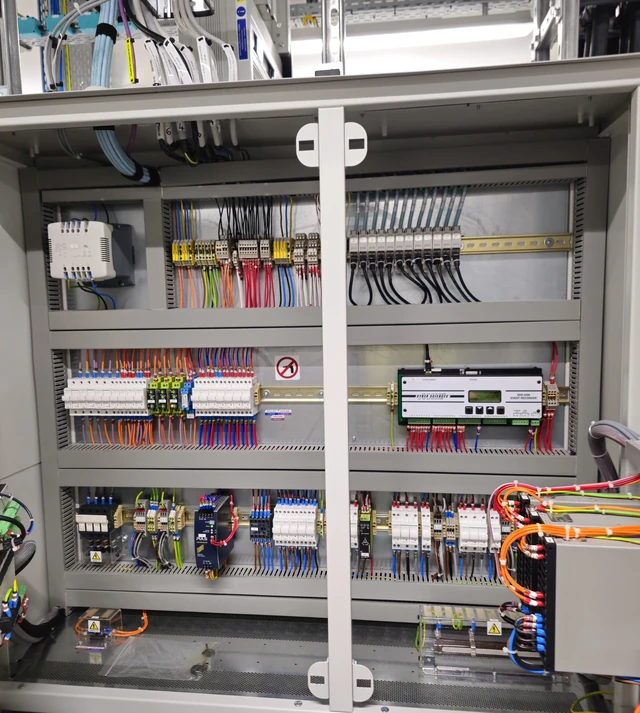
- Control panels of all kinds: control cabinets and industrial control panels, panelboards and distribution equipment, in MEP systems as well as on machines and production lines. Outside and inside, with particular attention to operator controls, connections and internal components.
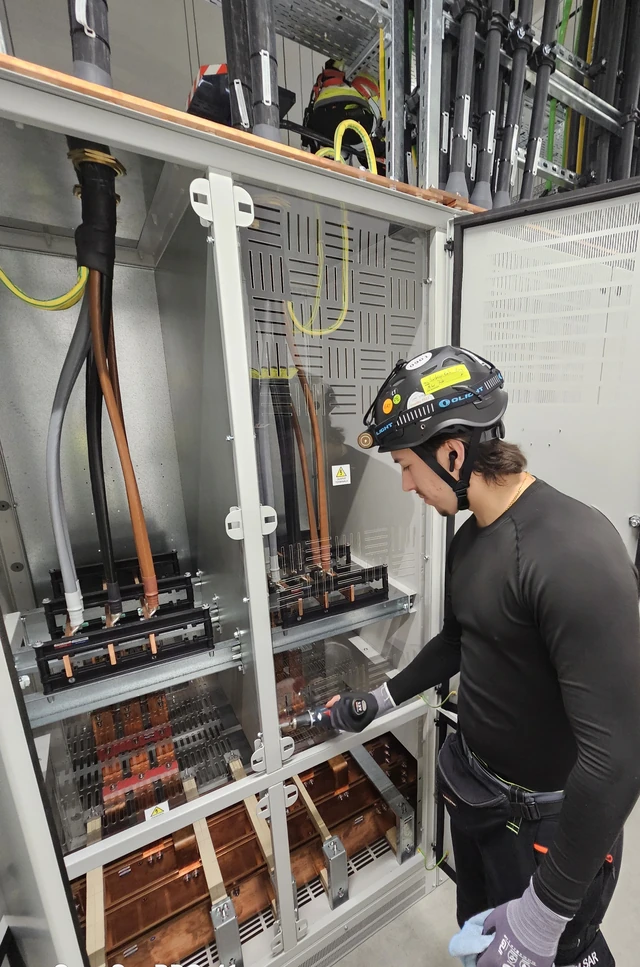
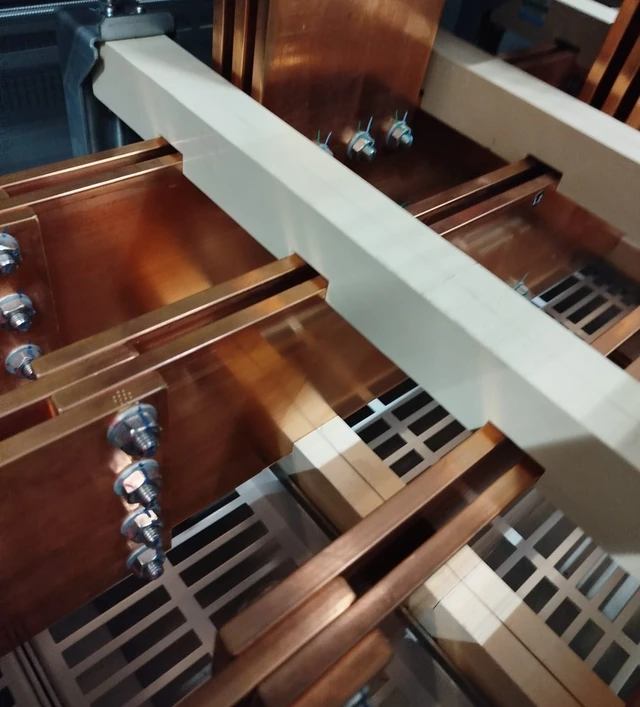
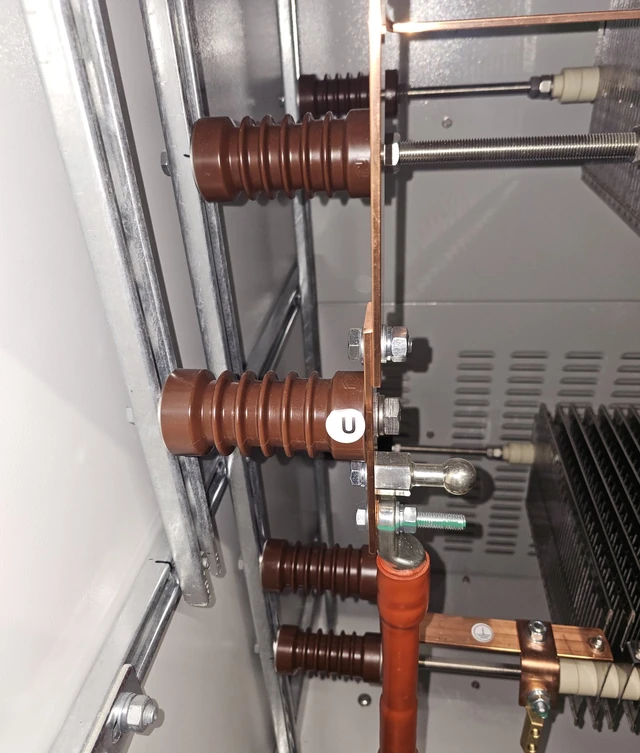
- Busbars and insulators: dust and other deposits on busbars, insulators and the surrounding surfaces.
- Terminations and wiring: terminal blocks and connection areas, accessible wiring and switching device housings.
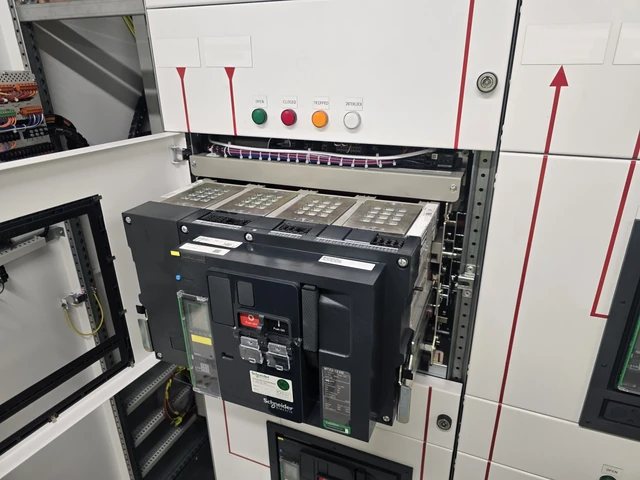
- Circuit breakers: inside and out, including racked-out drawout breakers.
Everything inside the equipment is cleaned only when it is de-energized and locked out.
Electrical room and switchgear room cleaning
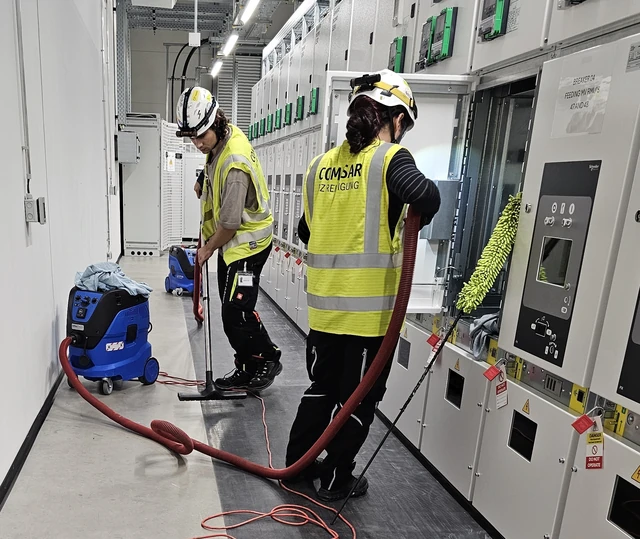
Switchgear sits in a room that needs cleaning too. In MV and LV areas, we clean the rooms and the associated switchgear, including floors and the surrounding area. Cable trays in the room are included as agreed. Read more in our article Cable tray cleaning.
De-energized only: who does what
Under the German accident insurance regulation DGUV Vorschrift 3, work on energized parts is generally prohibited. The standard procedure is to establish a de-energized state using the five safety rules:
- Disconnect
- Lock out and tag out to prevent re-energizing
- Verify the absence of voltage
- Ground and short-circuit
- Cover or barricade adjacent energized parts
This is done by the facility's qualified electrical personnel. They disconnect and lock out the equipment and release the work area to us. Our team cleans within this release, under the direction and supervision of the qualified electrical personnel. We start only once the work area has been released. We do not clean energized equipment.
How much needs to be shut down
In a data center, the outage is usually the most complex part. According to the German electrical industry association ZVEI, how much has to be shut down depends on how the low-voltage switchgear is built:
- Fixed-mounted: As a rule, the entire switchgear is de-energized for maintenance.
- Plug-in: Shutting down the affected functional unit is sufficient.
- Drawout: Here too, only the affected functional unit is shut down. We also clean drawout breakers in the racked-out position.
Power distribution in data centers is usually redundant. Sections of the switchgear can then be de-energized one after another without taking down the IT.
It is most economical to schedule the cleaning during a planned outage, for example for maintenance or testing.
How we clean
- Dry cleaning as standard: We vacuum with H14 HEPA vacuums and clean with soft brushes and dry, lint-free wipes. This is also what the manufacturers' instructions specify.
- Metal debris: We also pick up steel chips and loose steel parts with magnets. A magnet does not attract copper or aluminum chips; those are vacuumed up.
- Cleaning agents: on insulating parts only if the manufacturer's operating or maintenance instructions specify them. Requirements differ from manufacturer to manufacturer: some allow an alcohol-based plastic cleaner for heavy soiling, others prohibit alcohol and solvents or allow only one specific, named product. If no agent is specified, we clean dry.
- Compressed air: Several manufacturers rule out compressed air inside switchgear because it can blow chips and dust onto conductive parts. We therefore use it only where the manufacturer's instructions allow it: filtered, oil-free and dried, with simultaneous extraction through an H14 filter.
Handover before re-energizing
- No foreign objects: Tools and materials are completely removed, and no screws or metal chips remain in the equipment.
- Dry and closed: All surfaces are dry, and all covers are reinstalled.
- Findings reported: We photograph discoloration, tracking or corrosion and report it to the person responsible for the equipment. The evaluation is up to the qualified electrical personnel.
- Re-energizing: The facility's qualified electrical personnel inspect the equipment and re-energize it.
How we document work and findings is described on our page Documentation & reporting.
When switchgear and control panel cleaning makes sense
- After construction and renovation work and before commissioning, to remove construction dust, metal chips and installation debris. Read more under Pre-commissioning cleaning.
- During a maintenance or testing outage, when the equipment is de-energized anyway.
- When dust becomes visible, for example on ventilation grilles, on busbars or in control panels.
What does control panel cleaning cost?
That depends on the number and type of sections and panels, the level of contamination, access and the outages required. After a free on-site survey, you receive a quote.
Specialized company from Wehrheim near Frankfurt
COM.SAR IT Cleaning is a specialized company based in Wehrheim in the Taunus region, close to the data center hub of Frankfurt am Main. From here we work across Germany, Austria and Switzerland. The work is carried out mainly by our own employees. All of them are background-checked (German Führungszeugnis) and receive ESD fundamentals training in accordance with IEC 61340-5-1. Our general liability insurance covers bodily injury and property damage up to 10 million euros.
Sources
- DGUV Vorschrift 3 “Elektrische Anlagen und Betriebsmittel” (German accident insurance regulation on electrical installations and equipment), with implementation instructions (§ 6, § 8).
- DIN VDE 0105-100 (VDE 0105-100), Operation of electrical installations (five safety rules).
- ZVEI: Bemessungsdaten einer Niederspannungs-Schaltgerätekombination – Bedienen und Warten (operating and maintaining low-voltage switchgear assemblies), May 2015.
- IEC 60664-1, Insulation coordination for equipment within low-voltage supply systems (pollution degree 3).
- Siemens: operating instructions NXAIR (110-0134.9, Rev. 14, 2019) and 8DJH (500-8384.9, Rev. 10, 2017), cleaning and cleaning agents.
- ABB: MNS Service Manual (1SXH900002M0208, Rev. I, 2024), cleaning of insulating parts and compressed air.
- Schneider Electric: PIX Standard User Guide (GEX2563900SWE-00, 2025) and PrismaSeT Active (DOCA0203EN-02, 2021), cleaning.