
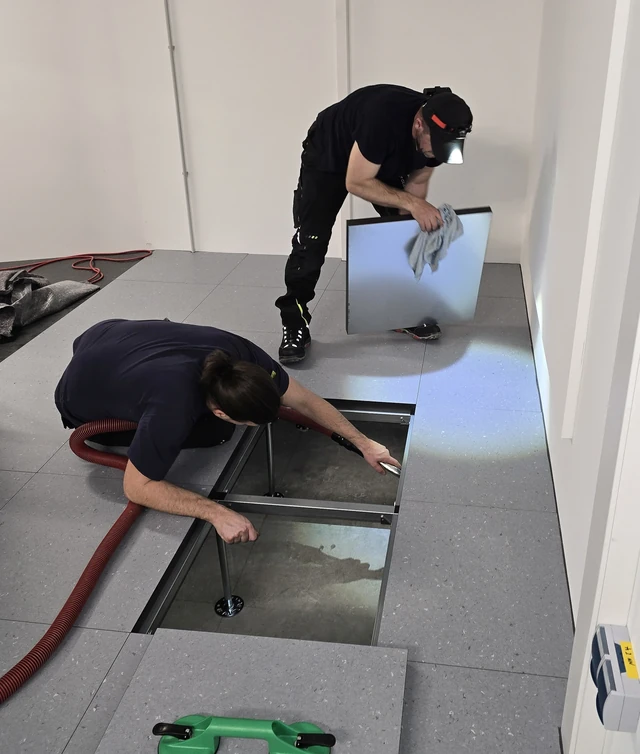
Why the raised floor needs to be clean
In many data centers, the raised floor also serves as the supply air plenum for the cooling system. The cooling units push conditioned air into the void. It rises through perforated tiles in front of the racks and is drawn in by the servers. Dust, fibers or drilling dust in the void are carried straight to the equipment with the supply air. A clean floor finish says little about the void beneath it. Without a clean supply air path, ISO Class 8 under ISO 14644-1 is hard to maintain.
What we clean
- Void and slab: We vacuum the slab in the raised-floor void. Uncoated concrete is only vacuumed; sealed or coated slabs are additionally damp-wiped afterward.
- Substructure: We clean the accessible pedestals and stringers without altering them. We clean pedestal heads and supports so the panels sit flat again.
- Cable routes and pipework: We clean cable trays and pipework as far as they are accessible. We do not move cable bundles without authorization.
- Debris: We pick up cable scraps, cable ties, packaging and screws. When they indicate earlier work, we collect them rather than vacuuming them up.
- Floor panels: We clean removed panels separately from the void, including their undersides. We vacuum perforated tiles and grilles, because dust collects in their openings. Every panel then goes back to exactly the same position.
- Panel surfaces: We clean according to the floor manufacturer's care instructions so that static-dissipative surfaces keep their ESD properties. On request, we apply a static-dissipative floor finish (ESD finish) where the floor manufacturer permits it.
- Floor restoration: Where needed, we deep-clean and restore raised-floor surfaces, using dry ice blasting where suitable. We use dry ice only when the area is out of service. Because the CO₂ released collects in the void, we plan ventilation and CO₂ monitoring in advance.
Hollow floors too
In addition to raised floors, we also clean hollow floors. The difference lies in the surface: on a raised floor (EN 12825), individual panels rest on pedestals, and every panel can be lifted out. On a hollow floor (EN 13213), a continuous screed lies on the substructure. The void can then only be reached through fixed openings, such as access openings or inserted raised-floor sections. Through these openings, we clean the void as far as can be reached from there. With an inspection camera, we can also see into areas that cannot be viewed directly from the opening. Anything that cannot be reached is recorded in the report.
During live IT: cooling, structure and detectors
We usually clean raised floors while IT keeps running. To do this, we agree three things with you in advance:
- Cooling: Every open panel is a hole in the supply air plenum. Air escapes there instead of reaching the perforated tiles in front of the racks. We therefore work section by section and keep each opening open only as long as necessary.
- Structure: The panels support each other as a system. One manufacturer, for example, specifies taking no more than three panels out of one row and avoiding "islands." We define for each room how many panels may be open at once. Openings are protected while work is underway.
- Detectors and suppression: Disturbed dust can trigger detectors. The operator's responsible person deactivates the affected detectors for the duration of the work, and they are usually also covered. We start only once this has been confirmed, and we report the end of the work.
How raised floor cleaning works
- Define the section and cordon off the openings.
- Lift the panels: with suction lifters, never with screwdrivers or chisels.
- Pick up larger items: cable scraps, cable ties, screws.
- Vacuum: slab and substructure with H14 HEPA vacuums. No compressed air and no blowing out, because that spreads dust through the entire supply air path.
- Wipe where the slab allows it. Panels and their edges must not get wet.
- Replace the panels: in their original positions without rotating them, including the perforated tiles. We check each panel for proper seating.
- Next section: Only then do we open the next area, until the entire raised floor has been completed.
Special case: zinc whiskers
The undersides of some steel raised floor panels are zinc-coated, often along with the pedestals and stringers. Fine, conductive metal filaments known as zinc whiskers can grow on them. They are dislodged mainly when panels are lifted or cables are pulled under the floor, and they can cause short circuits in IT equipment. Where whiskers are suspected, we plan the cleaning with particular care. How to detect zinc whiskers is explained in our article Zinc whiskers in data centers.
What you receive after cleaning
We check and document completed sections. The report also covers:
- locations that were concealed or inaccessible
- missing or damaged seals at cable cutouts
- damaged panels, unusual supports and other unexpected conditions
- an uncoated concrete slab that keeps releasing fine dust itself
Photos and particle measurements can be added where commissioned and permitted. More on this under Documentation & reporting.
When raised floor cleaning makes sense
- After construction and renovation and before commissioning, to remove construction dust and installation residue.
- After work under the floor: The void may then contain cable scraps, drilling dust or installation debris.
- When dust becomes visible, for example on perforated tiles, fan grilles or filters.
- Regularly: In our experience, one deep clean of a data center a year is enough if the air conditioning units have good filters and the room sees little foot traffic and little work. Under heavier use, we recommend two deep cleans a year. A check of individual floor sections shows whether the raised floor needs cleaning as part of this. If it does, we open all sections one after another. Only then are the supports and the undersides of the panels cleaned as well.
What does raised floor cleaning cost?
The price depends mainly on the floor area, the height and accessibility of the void, cable density, contamination and the available work windows. The floor in the void also matters: a painted or epoxy-coated floor is smooth and easier to clean than bare concrete. The floor system and the required level of documentation also play a role. After the site survey, you receive a quote with a clearly defined scope. The initial consultation and on-site survey are free of charge. See What does data center cleaning cost? for the factors that apply to an entire data center.
Specialist company from Wehrheim near Frankfurt
COM.SAR IT Cleaning is a specialist company based in Wehrheim in the Taunus region, close to the data center hub of Frankfurt am Main. From here we work across Germany, Austria and Switzerland. The work is carried out mainly by our own permanent staff. All of them provide a certificate of conduct (German Führungszeugnis) and receive ESD fundamentals training in accordance with IEC 61340-5-1. Our business liability insurance covers personal injury and property damage up to 10 million euros.