
When particle count testing makes sense
- Before cleaning: It shows the baseline and where contamination is highest.
- After cleaning: A verification measurement at the same locations and in the same occupancy state confirms the result.
- At the handover of a new build: as evidence for acceptance, for example after pre-commissioning cleaning.
- Regularly under a maintenance contract: Comparing several dates shows whether dust ingress is changing, for example due to construction work, new supply air paths or more frequent access.
- After construction work or dust ingress: to clarify whether and where cleaning is needed.
- On its own, without a cleaning contract: for example as a check for your records or as a basis for deciding whether cleaning is needed.
ISO Class 8 limits
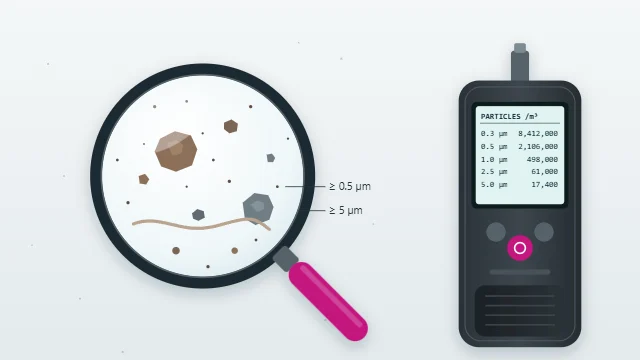
The values state the maximum permitted number of particles per cubic meter of air. Each value counts all particles at or above the stated size.
| Particle size | maximum per m³ of air |
|---|---|
| ≥ 0.5 µm | 3,520,000 |
| ≥ 1 µm | 832,000 |
| ≥ 5 µm | 29,300 |
For background, see our article ISO 14644-1 Class 8 in data centers.
How we test
- Sampling locations to the standard: Their number follows from the floor area. A room of 50 m² needs at least 10 locations, a room of 100 m² at least 16 and a room of 1,000 m² at least 27.
- Distribution: representative across the area, usually at working height. On request, we also test at agreed points, such as rack air inlets or inside a protected zone.
- Instrument: an optical particle counter that is calibrated annually to ISO 21501-4. It counts particles in six size channels from 0.3 to 10 µm and also records temperature and humidity. We enclose the valid calibration certificate with the report.
- Sample volume: at least 2 liters and one minute per location, as the standard requires.
- Evaluation: Every single location must meet the limit.
- Occupancy state: We record whether testing took place during operation or at rest. We usually test while IT equipment is live.
The test report
The report records sampling locations, times, conditions, values and observations, as well as temperature and humidity. We state the result in the form the standard specifies, for example “ISO Class 8; operational; 0.5 µm and 5 µm.” A floor plan shows where we tested. We agree in advance on what you need and who receives the documents.
If a location exceeds the limit
Then we look for the cause together with you, such as a leaking filter, unfiltered outside air or open penetrations to adjacent rooms. Cleaning the air paths, especially the raised floor, or changing the filters in the cooling units often helps. We then test again at the same locations.
What particle count testing does not cover
- Corrosive gases: Particle count testing does not capture hydrogen sulfide or sulfur dioxide. These are assessed with separate corrosion measurements under ANSI/ISA-71.04.
- Continuous monitoring: We test with handheld particle counters on agreed dates.
- Cleanrooms: Our focus is IT infrastructure, not cleanrooms. Cleanroom qualification, for example in the pharmaceutical or semiconductor industry, is the job of specialized testing bodies.
How testing works
- Agree on target and test plan: rooms, sampling locations, occupancy state, date.
- On-site testing, coordinated with your site contacts, usually while IT equipment is live.
- Report with values, assessment and notes.
- If needed, cleaning and a verification measurement at the same locations.