
CLEAN INSIGHTS / Cleaning
Cable tray cleaning: trays, risers and fiber raceways
Published on .
Cable trays, wire mesh trays, riser trays and yellow fiber raceways: why dust collects there and how we clean cable pathways in data centers.
SUMMARY
Key takeaways
- Cable trays are long, open surfaces above the racks, in the ceiling plenum and under the raised floor. Dust stays there because hardly anyone ever sees them.
- Cooling air flows across the trays and can carry that dust on, into the racks and equipment.
- The yellow fiber raceways are made of plastic. Plastic can build up a static charge and then holds on to dust.
- We vacuum with H14 HEPA filters and also clean underneath the cables wherever they can be lifted safely.
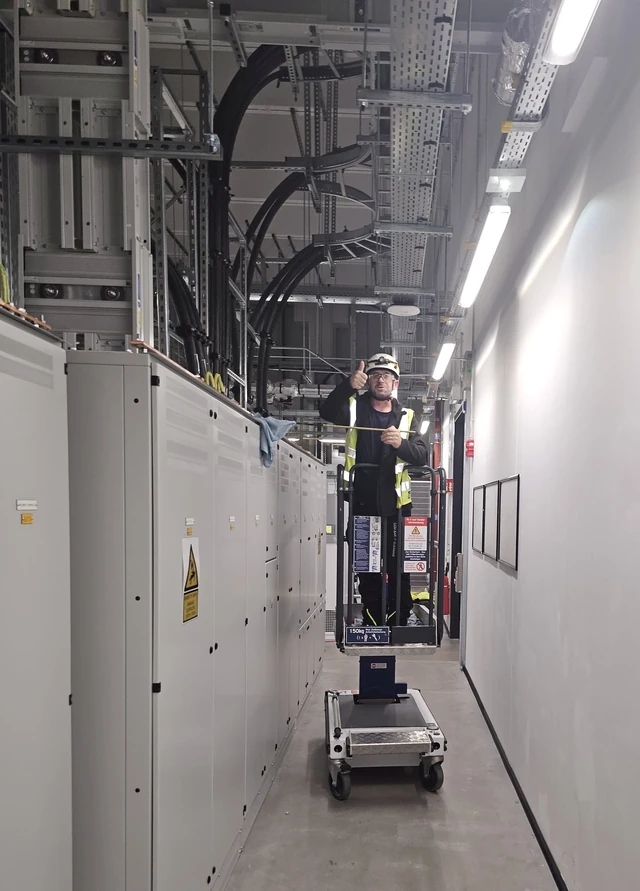
- At height, we work from aerial lifts. How vertical riser trays are cleaned depends on the shaft.
Types of cable pathways
On site, almost everything is called a “cable tray.” The trade distinguishes several types. The international standard IEC 61537 covers “cable tray systems and cable ladder systems,” which support and accommodate cables. In the US, OSHA’s electrical regulations list ladders, troughs, channels and solid-bottom trays as cable tray systems. Enclosed raceways are a separate category.
Open trays, run horizontally
- Ventilated trough tray or solid-bottom tray: a sheet-metal trough, usually perforated. This is the most common type.
- Wire mesh tray (wire basket tray): welded wire, lightweight. Typical in data halls and telecom rooms.
- Ladder tray: two side rails joined by rungs, for heavy cables and long spans between supports. Above the racks, it is often called a ladder rack or cable runway.
Run vertically
- Vertical riser tray: a ladder tray or trough that runs vertically from floor to floor, usually in a riser shaft.
Enclosed raceways
- Raceway, surface raceway or wireway: mounted on walls or ceilings, with a cover. This also includes the slotted wiring duct inside control panels.
Especially common in data centers
- Fiber raceway: the mostly yellow plastic channels above the racks that carry fiber optic cables.
According to the manufacturer OBO Bettermann, metal cable trays are usually made of steel or stainless steel. Steel is zinc-coated against corrosion, for example pre-galvanized, electro-galvanized or hot-dip galvanized.
Why dust collects on cable trays
A cable tray is a long, horizontal surface, often overhead or above a drop ceiling. Nobody sees what settles there day to day, and routine janitorial cleaning does not cover it. As a result, trays often carry years of dust and fibers.
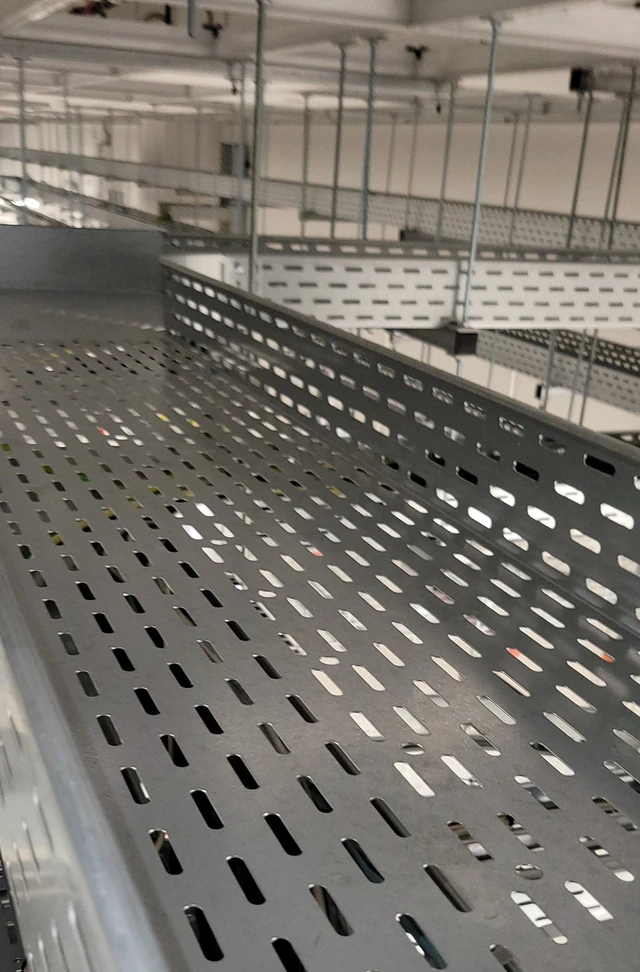
Airflow adds to this. In data centers and server rooms, cooling air moves through the room constantly: above the racks, through ceiling plenums and through the raised floor. It flows across the trays. Anything lying loose there can be picked up and carried into the racks and equipment.
Construction work creates especially large amounts of dust. Drilling and grinding dust settles on every surface, including the trays above the racks. Read more in our article Construction dust in IT.
Yellow fiber raceways: plastic attracts dust
The yellow channels for fiber optic cables are made of plastic. In one widely used system from a major manufacturer, the channel is rigid PVC and the fittings are PC/ABS plastic.
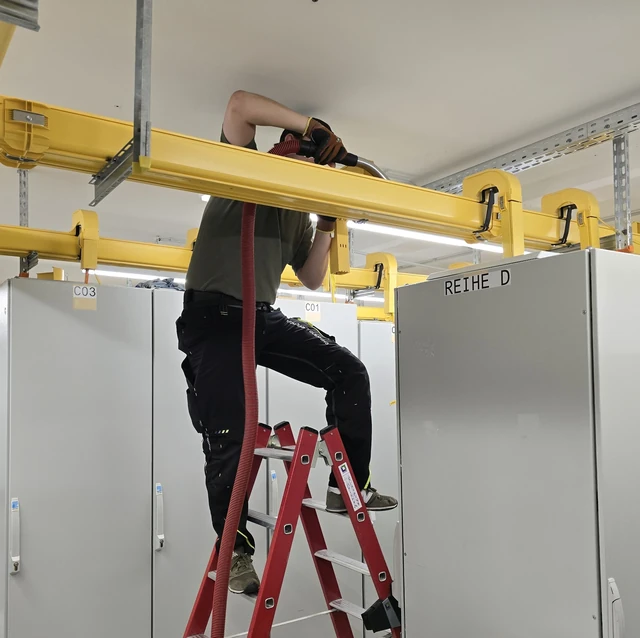
Plastics are very poor conductors of electricity. According to the Fraunhofer Institute LBF, friction easily gives them an electrostatic charge, and that charge stays on the surface. Charged plastic surfaces hold on to dust. As the German trade journal Kunststoffe reports, manufacturers add antistatic agents to plastics to prevent exactly that.
From our experience: We often find considerably more dust in the yellow fiber raceways than you would expect from below.
For cleaning, this means: we carefully vacuum off heavy dirt. The raceways are not rubbed dry, because that would charge the plastic again.
Cleaning underneath the cables
Most of the dust is not on top of the cables but underneath them, on the bottom of the tray. Wherever possible, we gently lift the cables and vacuum underneath. With patch cords and most data cables, that is easy.
We do not lift heavy power cable bundles. They are too heavy, and the risk to the cables and terminations would be too high. There, we clean the accessible surfaces next to and on top of the cables. Cables are never rerouted: they stay exactly where they were installed.
Vertical riser trays in shafts
Riser trays run vertically through a shaft, often over several floors. How they are cleaned depends on the shaft: its size, the access points on each floor and how much clearance there is next to the tray.
Where a shaft is large enough, we work from an aerial lift. Otherwise, we determine the approach during the site survey. In the shaft, too, dust is vacuumed up so it does not fall down and spread across the floors below.
Where trays pass through walls and floors, there are firestop systems. We leave them untouched. If we notice any damage, we record it in our report.
Enclosed raceways
We usually clean covered raceways from the outside. Because they are closed, hardly any dust escapes from inside into the room air. We clean the inside only on request, for example after construction work while the raceway was open.
How we work
- Clarify first: Which trays are included in the scope? Where are detectors and fire suppression systems? Which areas are off-limits? The operator’s authorized representative disables nearby smoke detectors or aspirating smoke detection for the duration of the work.
- Top to bottom: Trays first, then racks and floor. That way, no dust falls onto surfaces that have already been cleaned.
- Capture dust, don’t stir it up: We vacuum with H14 HEPA vacuum cleaners and use brushes and lint-free cloths. Fine dust is captured instead of being spread through the room. For hard-to-reach spots, we also use tools we developed ourselves.
- Working at height: We reach high trays with aerial lifts. Our team members hold the IPAF PAL Card for vertical lifts such as scissor and mast lifts (MEWPs, category 3a). We prefer to use lifts that are already available at the client’s facility or on site.
- Watch for zinc whiskers: As with all galvanized parts in the airflow path, we look out for zinc whiskers on older trays: fine, conductive metal filaments. If we notice anything, we inform the operator. Read more in our article Zinc whiskers in data centers.
- Hand over section by section: We document with before and after photos. Acceptance takes place during a joint walkthrough.
Trays above the racks can usually be cleaned during live operation. What needs to be coordinated is described in our article Cleaning a live server room. We clean trays under the raised floor together with the subfloor plenum; see Raised floor cleaning.
Frequently asked questions
Are cables moved for cleaning?
They are never rerouted. We gently lift lightweight data cables to vacuum underneath them. Heavy power cable bundles stay where they are.
Can cleaning be done during live operation?
For trays above the racks, usually yes, with H14 vacuums and without compressed air. We coordinate nearby detectors and off-limits areas with the operator in advance.
How often should cable trays be cleaned?
It makes sense to include the trays in the room’s regular cleaning and to check them additionally after construction and cabling work. How often cleaning makes sense is covered in our article How often does a server room need cleaning?
Do you also clean vertical riser trays in shafts?
Yes. How depends on the shaft, for example from an aerial lift. We determine the approach during the site survey.
What does cable tray cleaning cost?
That depends on the length and height of the trays, the cable fill, access and the level of contamination. After a free on-site survey, you receive a quote.
Sources
- IEC 61537 / DIN EN 61537 (VDE 0639): Cable management – Cable tray systems and cable ladder systems.
- OSHA: 29 CFR 1910.399, Definitions applicable to this subpart (“Cable tray system,” “Raceway”).
- OSHA Fact Sheet: Electrical Safety Hazards of Overloading Cable Trays, DSTM 03/2006.
- OBO Bettermann: Leitfaden Kabeltragsysteme (cable tray systems guide). Edition 10/2022.
- Panduit: FiberRunner 12x4 Routing System, Specification Sheet (material data).
- Fraunhofer LBF: Elektrostatische Aufladung von Kunststoffen (electrostatic charging of plastics), poster.
- Kunststoffe 10/2021, Carl Hanser Verlag: “Keine Chance für Stäube” (antistatic additives for plastic parts).
FOR YOUR PLANNING
Your checklist at a glance
- Which trays are included: above the racks, in the ceiling plenum, under the raised floor, in riser shafts?
- Yellow fiber raceways included?
- Height and access clarified, aerial lift available on site or to be rented?
- Nearby detectors and fire suppression systems coordinated with the operator?
- Enclosed raceways outside only, or inside as well?
- Trays checked additionally after construction and cabling work?